

A Compliance Checklist Is Not a Cybersecurity Strategy

Geoff Wilson
A Compliance Checklist Is Not a Cybersecurity Strategy
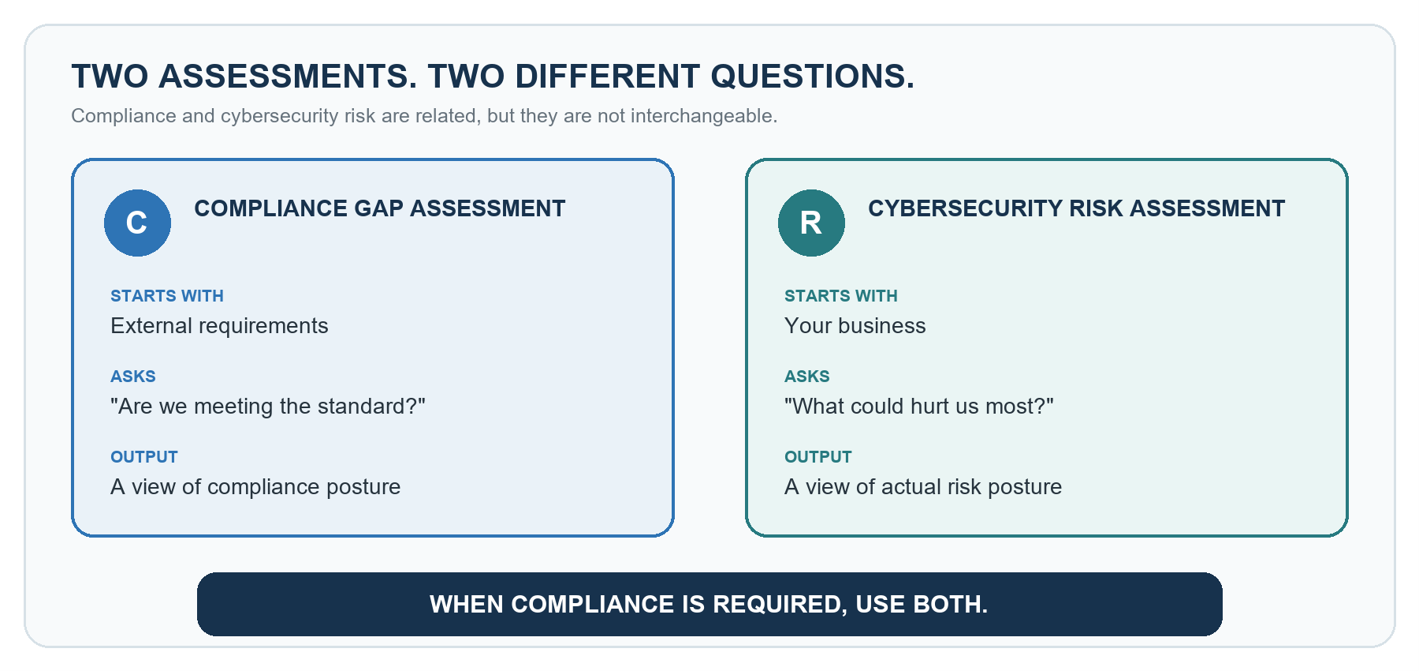
Compliance shows how you measure against an external standard. A risk assessment shows what could hurt your business.
If your organization has compliance requirements, a compliance gap assessment can answer an important question: Are you meeting them? What it cannot tell you is whether you are managing the cybersecurity risks that matter most to your business.
Compliance frameworks provide a valuable baseline. Regulators, customers, industry groups, insurers, and other third parties develop requirements to protect the information, systems, or transactions they care about. But those requirements were not designed around your organization’s specific systems, operations, vendors, threat exposure, or tolerance for disruption.
That is why compliance should support your cybersecurity program, not define your cybersecurity strategy.
Compliance Measures Someone Else’s Risk Profile
Whether you are working toward HIPAA, PCI DSS, CMMC, GLBA, a customer security requirement, or another standard, a compliance gap assessment asks: How does our environment compare with this defined set of requirements?
That question matters when you have a regulatory, contractual, or business obligation. Still, an issue that falls outside the standard may remain a serious risk to your organization. You can satisfy every item on a checklist and still have inadequate recovery capabilities, unmanaged systems, excessive third-party access, or identity weaknesses that could cause widespread damage.
A compliance report tells you where you do not meet the standard. It does not automatically tell you what could hurt your business most.
A compliance assessment tells you where you do not meet the standard. A cybersecurity risk assessment tells you what could hurt your business.
A Cybersecurity Risk Assessment Starts With Your Business
A cybersecurity risk assessment asks a different set of questions: Which systems, data, and processes are most important? What threats could realistically affect them? Where are you vulnerable? What would the business impact be? Which risks are already managed, and where should you invest next?
The result is a picture of your actual cybersecurity risk. That gives leadership the context to decide which risks to mitigate, transfer, avoid, or accept. It also helps focus limited money, people, and time on the issues that matter most.
Even when compliance findings and cybersecurity risks overlap, their priorities may differ. A missing control can be urgent because a standard requires it, because it represents an unacceptable business risk, or both. Leadership should know which reason is driving the decision.
If You Need a Compliance Assessment, Do Both
For organizations with regulatory, contractual, or other compliance obligations, this is not an either-or decision. Complete the compliance gap assessment you need, but pair it with a broader cybersecurity risk assessment.
Your compliance posture: Where you meet, or do not meet, requirements established by a regulator, customer, industry standard, insurer, or other external party.
Your cybersecurity risk posture: Where your organization faces meaningful risk based on its actual technology, operations, threats, vulnerabilities, and potential business impact.
Together, these views help leadership separate checklist work from risk-reduction work, identify where the two reinforce each other, and make better-informed security investments.
Start With Risk, Not the Checklist
Compliance matters, and organizations should address their obligations. But completing a checklist or passing an audit should not be mistaken for having an effective cybersecurity program.
The better question is not simply, “Are we compliant?” It is, “Do we understand our cybersecurity risks, and are we managing the risks that matter most to our organization?”
At Go Security Pro, we conduct both cybersecurity risk assessments and compliance gap assessments, usually in tandem. When compliance is required, we can evaluate your organization against those requirements. Our broader goal is to help leadership understand actual cybersecurity risk so security investments are based on what matters to the business, not just what appears on a checklist.
Need to understand your real cybersecurity risk?
Start with a cybersecurity risk assessment. If you also have compliance requirements, we’ll help you evaluate those alongside your broader risk picture.
About the Author
Geoff Wilson
Geoff Wilson is CEO and Founder of Go Security Pro and is an innovative cybersecurity thought leader with deep experience in defensive cybersecurity strategies. Having trained at the National Security Agency, Geoff brings 20 years of cybersecurity experience to your organization.
Geoff has a Master’s of Information Security from Carnegie Mellon University and a Bachelor’s of Computer Science from the University of Oklahoma. He taught a graduate-level Information Security course at the University of Oklahoma for four years. Geoff is a published author, has worked for the National Security Agency, was a federal cybersecurity auditor, and has consulted with the Executive Office of the President.
Geoff is a business leader having founded Go Security Pro in early 2019 with his wife and co-founder Susan Wilson. Geoff regularly speaks at conferences, presents to executive leadership and boards, and can get in the technical weeds with IT professionals.
Geoff treats every engagement as a knowledge transfer opportunity and every client with the utmost care. He is ready to assist you with your cybersecurity challenges.
